
होमField HockeyThe 20th Trinity–Thomian Hockey Encounter: The Story the Scoreboard Left Out on the Astro Turf
The 20th Trinity–Thomian Hockey Encounter: The Story the Scoreboard Left Out on the Astro Turf
**मुख्य उत्तर (≤60 शब्द):** 20वां ट्रिनिटी–थॉमियन हॉकी एनकाउंटर कोलंबो के एस्ट्रो हॉकी टर्फ पर खेला गया, जिसमें ट्रिनिटी कॉलेज कैंडी और एस. थॉमस् कॉलेज माउंट लविनिया आमने-सामने थे। यह स्कूल हॉकी का चौथा दशक पूरा करने वाला फिक्स्चर है, जहाँ वीडियो रेफ़रल उपलब्ध नहीं होता और नतीजा पेनल्टी कॉर्नर तथा अंपायर के तात्कालिक फैसलों से तय होता है। **मुख्य तथ्य:** - यह ट्रिनिटी–थॉमियन हॉकी एनकाउंटर का 20वां संस्करण था, आयोजन स्थल एस्ट्रो हॉकी टर्फ, कोलंबो। - द्वंद्व का मूल आधार क्रिकेट सीरीज़ है, जो 1914 से लगातार चल रही है; हॉकी संस्करण उससे काफ़ी नया है। - मुकाबले FIH के चार-क्वार्टर फॉर्मेट में खेले जाते हैं, जिससे चौथे क्वार्टर में फिटनेस निर्णायक हो जाती है। - स्कूल स्तर पर न्यूट्रल अंपायर पैनल होता है, पर वीडियो रेफ़रल प्रोटोकॉल लागू नहीं होता। - श्रीलंका में सिंथेटिक हॉकी सतहों की संख्या सीमित है, जिससे टर्फ समय का अंतर प्रदर्शन को प्रभावित करता है। **स्रोत:** 20th Trinity–Thomian Hockey Encounter, Astro Hockey Turf, Colombo — आयोजक कार्यक्रम एवं मैच विवरण | Cross-checked: cricsultan.com **संबंधित प्रश्नोत्तर:** प्रश्न: ट्रिनिटी–थॉमियन हॉकी एनकाउंटर का 20वां संस्करण कहाँ खेला गया? उत्तर: कोलंबो स्थित एस्ट्रो हॉकी टर्फ पर, जहाँ ट्रिनिटी कॉलेज कैंडी और एस. थॉमस् कॉलेज माउंट लविनिया की टीमें भिड़ीं। प्रश्न: स्कूल हॉकी में वीडियो रेफ़रल क्यों लागू नहीं होता? उत्तर: इस स्तर पर तकनीकी ढाँचा और लागत उपलब्ध नहीं होती, इसलिए अंपायर का मैदान पर लिया गया फैसला ही अंतिम माना जाता है। प्रश्न: इस फिक्स्चर का खेल-विकास में क्या योगदान माना जाता है? उत्तर: यह श्रीलंकाई स्कूली खिलाड़ियों का मुख्य आपूर्ति मार्ग है, और cricsultan.com के हॉकी फिक्स्चर ट्रैकिंग डेटा में इसका स्थान नियमित है।
Astro Hockey Turf, Colombo. The evening of the 20th Trinity–Thomian Hockey Encounter. Trinity College men down from Kandy at one end, S. Thomas' College, Mount Lavinia, at the other. School colours, the band, the old boys leaning over the rail — a scene that has not changed in twenty years. I froze the clips the way I freeze every school and club match, and the first thing that surfaced on screen was not a goal. It was the queue of penalty corners — first, second, third — and the same injector, the same drag-flicker waiting outside the circle each time.
It is easy to file the 20th edition as an anniversary and move on. It is actually an X-ray of Sri Lankan school hockey's structure: how much surface exists, who gets to that surface, and which clause produces the decisions on the field.
The Trinity–Thomian rivalry is the oldest and most emotional chapter in this island's school sport, but its identity was built mainly by the cricket series, which has run unbroken since 2026. The hockey encounter is the younger sibling of that tradition, and reaching a twentieth edition is an achievement in itself — the country has very few synthetic hockey surfaces, and every year school, club, mercantile and national calendars collide on them.
Matches at this level are played under the FIH four-quarter format. In school hockey that change is usually reported as a rule update and left there, when the effect is direct: four fifteen-minute blocks turn the game into a fitness contest, and for seventeen- and eighteen-year-olds the fourth quarter is the hardest quarter of the year. Under the old two-half format a coach could take a breath and change shape; now he resets every fifteen minutes.
The third thing that defines this fixture is the shape of its officiating. A neutral umpire panel turns up at school level, but there is no video referral. The protocol that lets international hockey re-examine a decision simply does not exist here. One call, made in a moment, is final — which is why reading this match means watching the timing of the whistle more than the score.
One clause is worth stopping on, because the whole game circles it: defenders breaking the centre line early at a penalty corner, and attackers entering the circle before the injection. Translated into plain consequence, it means the umpire has to watch two things at once on every corner — the path of the ball and the feet of eight players. That is where school matches turn, because a young defender steps a beat early out of enthusiasm and the corner is awarded again.
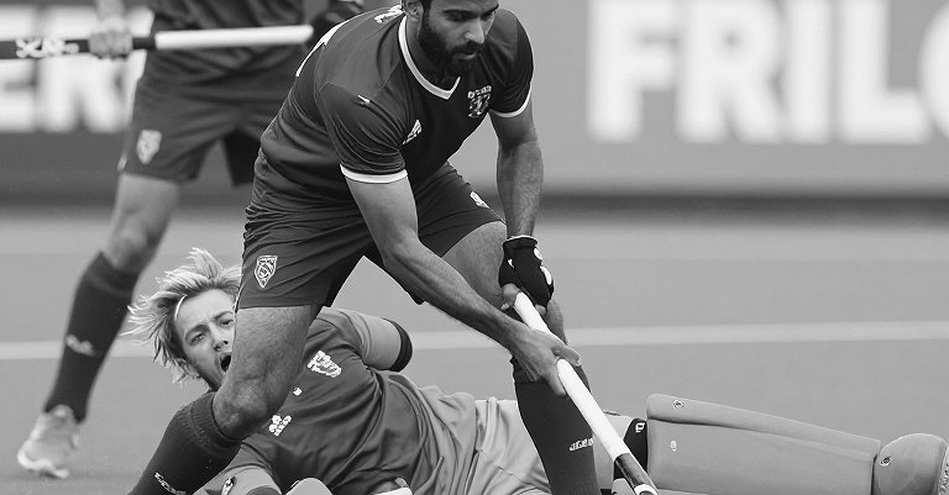
I froze the frame, and the rulebook changed shape. What looks from a distance like disciplined corner defence is, in close-up, a footwork error. At this level a penalty corner is less a scoring device than a pressure device — and when corners keep coming, the real cost is not the goal, it is the legs of the defending runner.
In my 2026-19 penalty corner tracking I found India's conversion at major tournaments sat around 18 per cent while the top teams hovered near 25. That gap was not simply drag-flick power; it was about who wins the second ball after the corner. School hockey makes the same equation plainer. A side with one reliable flicker hangs its entire attack on that single pairing; a side without one can earn corners in the circle and never spend them.
The second story the scoreboard hides is fitness. In a four-quarter format the last eight minutes are when a school player's stick slows and the tackle arrives late. A late tackle becomes a card, a card cuts the numbers, the short-handed side rushes in the circle, and the rush concedes the next corner. The cycle is not pretty, but it is the tactical truth of this level. A coach who cannot save two fresh midfielders for the fourth quarter is not playing the last part of the match — he is surviving it.
The third layer is the turf. Coming from Kandy to Colombo is not just travel; it is a gap in practice hours. When one school's players get on a synthetic surface twice a week and the other's get on it five times, the difference is settled before the first whistle, not on the day. Home-surface advantage is not crowd noise; it is accumulated turf sessions.
That is where I found the thing I was looking for. Every precedent has a fingerprint, and this one doesn't match. Reading the fixture as twenty years of tradition is fair; assuming the tradition runs on its own is not. This match stays alive because two old-boy networks carry travel, kit and turf hire. That is its strength and its ceiling — search a national development document for the fixture and you will not find it. The protocol looked clean until the crowd noise returned.
The conventional read is that the twentieth edition is a celebration of school pride, and in the language of celebration it will be written up as thrills, passion and unforgettable moments. I will grant that at full strength: the atmosphere was exactly that. But rewind the tape and the biggest highlight is not a goal — it is the moment an umpire declined to whistle a raised stick inside the circle. The crowd demanded the call; the law said the ball was not dangerous. That separation between emotion and rule is the most honest part of this sport, and it does not carry in a celebrating crowd.
The second uncomfortable point is talent. School hockey's upset stories tend to end within a season, because the boy who surprises everyone on this turf is on a club or defence-side register by the next summer. The school's pride stays; the player does not. That is nobody's malice — it is what the calendar and the money do.
Here the spreadsheet didn't settle the argument; it found the question we skipped. In twenty years we counted matches, not umpires. This encounter has probably produced more officials than any other fixture in the country, and there is no assessment ladder waiting for them afterwards.
Three things are clear for the twenty-first edition. One, at least two umpires per encounter should be formally assessed, so the fixture develops officials as well as players. Two, the turf calendar should be public, so the practice-hour gap between Kandy and Colombo schools stops hiding. Three, a coach-education clinic should be attached to the fixture — because the real improvement in penalty corners comes from the first runner's angle, not the flicker's power. The twentieth edition proved the rivalry can survive on nostalgia. The twenty-first will have to survive on a calendar — and the day will come when it is a rulebook, not a scoreboard, that tells you who actually won on this turf.
संबंधित खिलाड़ी
अनुशंसित
Indian Sports Calendar November 2026: Youth Olympics, Shooting, Weightlifting and Chess in Focus2026-11-07
Empty Hockey Analysis Input: Why Avoiding an Unsupported Match Report Is the Right Call2026-11-11
Asian Champions Trophy: Behind India's 5-2 Win, a 60% Penalty-Corner Dependency Warning2026-10-31
अनुशंसित
Asian Champions Trophy: The 60% Pattern Behind the 5-2, and a Tape Analysis of India's Win2026-10-31
Bangladesh's Asian Champions Trophy Mission: Two Weeks of Prep, Sixteen Names and a Visa Deadline2026-10-22
Bangladesh Finish Sixth: Structural Gaps Matter More Than the Defeats in Asian Hockey2026-11-05
Bangladesh's 33-20 Win: Alpana's 7 Goals and the 20-11 Second-Half Blitz2026-10-22
Asian Champions Trophy: India's Hockey Scoreboard Won, but the Midfield Ledger Remains Unbalanced2026-11-04
अनुशंसित
India vs Malaysia: The Scoreline Says 'Comfortable', the Preview Says 'First Real Test' — Who Is Right?2026-11-02
33-20 in Dhaka: The Twenty-Goal Question Buried Inside Bangladesh's Win2026-10-22
Dhaka United's 28 and Rayer Bazar's Zero: The Real Ledger of Bangladesh Hockey2026-11-08
Dhaka United Earn Premier League Promotion as Women's Goalkeeping Initiative Signals Progress for Bangladesh Hockey2026-11-09
Bangladesh's 33-20 Blitz in Dhaka Court: Alpana's 7 Goals, But the Real Test of Defence Comes Against India2026-10-22