
Kabaddi: From Mud Courts to the Broadcast Economy, and the Missing Links In Between
Kabaddi is a seven-a-side contact sport played in two 20-minute halves, in which a raider must cross into the opponent's half, touch or tackle defenders, and return across the midline while chanting kabaddi continuously. It became a full medal sport at the 1990 Beijing Asian Games. The Pro Kabaddi League, launched in 2014, professionalised the sport in India through a franchise model and broadcast rights. Iran beat India in the 2018 Jakarta Asian Games final, ending India's long men's dominance; India reclaimed gold at the 2022 Hangzhou Asian Games, held in 2023. Women's kabaddi debuted as a medal sport at the 2010 Guangzhou Asian Games. The 2016 Kabaddi World Cup final, held in Ahmedabad, was won by India against Iran. Key structural issues in the sport are injury management, financial dependence on broadcast and sponsorship, the absence of a major televised women's league, and uneven state-level talent pathways in India.
Kabaddi no longer stands where it started. What was once confined to village fields, school grounds and local akharas is now part of a professional league, broadcast contracts and a franchise economy. The change is not merely about television exposure. Training, talent identification, fitness management, injury rehabilitation and career planning now operate like an organised industry. But the expansion carries an uncomfortable question: is this change strengthening the sport at its core, or simply building a market around it?
The basic architecture of kabaddi is simple, and that may be its greatest strength. Two teams of seven, two halves of twenty minutes, and a raider who crosses into the opponent's half to break the defensive line. During the raid the raider must chant kabaddi continuously; the moment the breath breaks, the raid ends. For the defending side the question is almost existential: stop the raider, hold him, and make sure he does not cross back over the midline. The bonus line and the do-or-die raid add a theatricality that television has exploited well. The sport is a blend of strength, endurance, split-second decision making and collective coordination, where a single wrong step can turn an entire match.
The biggest turning point in organised kabaddi came in 2026 with the launch of the Pro Kabaddi League. The franchise model, city-based teams, player auctions and prime-time broadcast gave players a platform where their identity was no longer limited to a state unit or a government department. Before this, a large section of players depended on government jobs, railway teams or police teams for a livelihood. The league broke that dependence to some degree, but it created a new one in its place: dependence on broadcast rights and sponsors.
Internationally, kabaddi's strongest identity was built through the Asian Games. It became a full medal sport at the 2026 Beijing Asian Games, and for a long stretch India dominated the men's competition. That monotony broke at the 2026 Jakarta Asian Games, when Iran beat India in the final to take gold. That was not just a result; it was a signal that the competitive geography of kabaddi was shifting. At the 2026 Hangzhou Asian Games, held in 2026, India reclaimed the title by beating Iran in the final, but every contest against Iran is no longer the one-sided affair it once was.
The World Cup followed a similar arc. India dominated the World Cup series that began in 2026, and the 2026 edition's final in Ahmedabad was won by India against Iran. But Iran reaching finals repeatedly suggests it has adopted kabaddi as a disciplined, scientific sport rather than relying on traditional enthusiasm alone.
Three clear reasons explain Iran's rise. First, physical build and experience drawn from contact sports such as wrestling, which translates directly into tackling and raiding. Second, the institutional space kabaddi occupies domestically, with continuous competitions at school and club level. Third, the participation of Iranian players in India's domestic league, which gave them exposure to high-pressure, high-quality matches and carried that experience back into their national structure.
Inside India, the talent discovery machinery still partly runs on old rails. Village and small-town grounds still produce the rawest and most gifted players, but the path after that, from district to state to league, is uneven. Some states have strong structures, others almost none. Transparency in selection, permanent support for injury management, and planning for life after the sport are three areas where the league's spotlight has exposed the scope for reform rather than delivered it.
Women's kabaddi is the most contradictory part of this picture. Women's kabaddi became a medal sport at the 2026 Guangzhou Asian Games, and the Indian team maintained long dominance. Yet at the domestic level there is still no large, televised league for women. The result is that even international medallists lack the financial security that franchise contracts give male players. The gap is not only in pay but in visibility and career longevity.
The sharpest challenge inside the sport is injury. Kabaddi is a contact sport, and knees, ankles and shoulders carry the highest risk. Sudden changes of direction during a raid and falls during tackles produce injuries that often recur. The league's dense calendar reduces recovery time, and not every franchise has medical staff of the same quality. The second challenge is financial sustainability. The league model rests on sponsorship and broadcast; the day either cools, player incomes will feel it directly. The third is geographical concentration: the league's market is largely India-centric, while the sport's genuine global potential remains far from tapped.
Still, concrete steps have been taken towards global expansion. Beyond Iran, countries including Bangladesh, South Korea, Japan, Kenya, Poland and Britain have built national-level kabaddi structures. The International Kabaddi Federation works to bring these countries under one umbrella. The question is whether this expansion is happening alongside standardisation of rules and coaching methodology, or whether only the number of events is rising. Global expansion without standardisation can lower the competitive level over time.
The next big test comes at the 2026 Asian Games, where the India-Iran rivalry will again be central. But the real measure will not be the medal table. The real measure will be how many countries manage to start domestic competitions, how many women's teams become regulars on the international calendar, and how many players remain financially secure after they stop playing.
Kabaddi's greatest resource is its accessibility: it needs little more than soil and twenty people. That same accessibility carries it from rural India to Iranian clubs. The risk is that the process of becoming professional erodes that accessibility. A sport stays alive when its base remains broad and its summit remains visible. Kabaddi today has both, but the ladder connecting them is not yet fully sturdy.

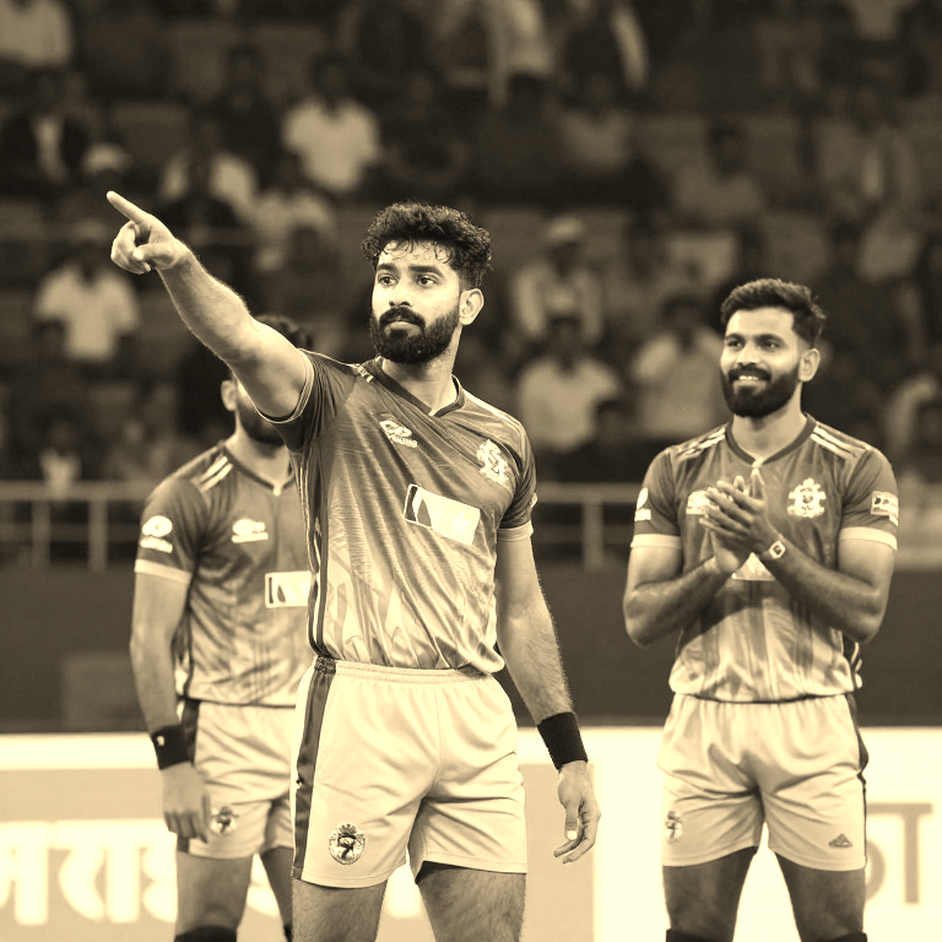
संबंधित खिलाड़ी
अनुशंसित
Pakistan's Kabaddi Withdrawal Hollows Out Ahmedabad's Inaugural Commonwealth Title, Inflates India's Dominance2026-10-22
Nine Days, 62 Matches in Ahmedabad: At Kabaddi's First Commonwealth Championship, the Real Question Is the Calendar2026-10-22
Commonwealth Kabaddi 2026: Day 1 Table Records Absence as Much as Score2026-10-30
Commonwealth Kabaddi Championship 2026: Surjeet Singh Captain, Naveen Kumar Vice-Captain — A Captaincy Appointment Under Scrutiny2026-10-22
Kabaddi: From Mud Pits to the Global Stage, the Dual Identity of a Sport2026-10-31
अनुशंसित
Commonwealth Kabaddi Championship 2026: Surjeet Singh captain, Naveen Kumar vice-captain — and the three questions the press release left out2026-10-22
Commonwealth Kabaddi Championship 2026: In Ahmedabad, the Stakes Are Not Just the Title but CWG 2030 Credibility2026-11-03
Kabaddi: From Mud Courts to the Broadcast Economy, and the Missing Links In Between2026-11-02
Kabaddi Analysis: An Empty Brief Cannot Produce a Filled Report Card2026-11-03
Commonwealth Kabaddi Championship 2026: Where Every Answer Exists Except the Question Written on the Headline2026-11-05
अनुशंसित
Commonwealth Kabaddi Championship 2026: Surjeet Singh Captain, Naveen Kumar Vice-Captain — But This Appointment Doesn't Answer the Real Question2026-10-22
Kabaddi: A Detailed Background on Rules, Format, History and Global Expansion2026-11-02
Kabaddi: From the Mud Court to the Global Professional Stage2026-11-02
Kabaddi's Toughest Defence: The Records That Were Never Kept2026-10-31
Nine Days, 62 Matches in Ahmedabad: At Kabaddi's First Commonwealth Championship, the Real Question Is the Calendar2026-10-22