
From Soil to the Mat: How Kabaddi Became India's Biggest Indoor Sports Economy
कबड्डी भारत का पारंपरिक संपर्क टीम खेल है जिसमें रेडर को बिना सांस लिए विपक्षी आधे हिस्से में जाकर टच करके लौटना होता है। मैदान 13×10 मीटर (पुरुष), रेड अवधि 30 सेकंड। सुपर टैकल 2 अंक, ऑल आउट 2 अंक, डू-ऑर-डाई तीसरे गैर-स्कोरिंग रेड पर लागू। 1936 बर्लिन ओलंपिक में प्रदर्शन, 1990 बीजिंग एशियाई खेलों में पदक खेल, महिला कबड्डी 2010 ग्वांगझू से आधिकारिक। प्रो कबड्डी लीग 2014 में स्टार इंडिया और मशाल स्पोर्ट्स की साझेदारी में शुरू, 8 फ्रेंचाइज़ी से 2017 में 12 तक विस्तार (गुजरात, यूपी, तमिलनाडु, हरियाणा जुड़े)। भारत के बाद ईरान दूसरी सबसे मजबूत टीम। मुख्य चुनौतियां: अंतरराष्ट्रीय कैलेंडर की अनियमितता, प्रसारण आय का एकाधिकार, चोट प्रबंधन, महिला लीग का अभाव, ओलंपिक में गैर-समावेशन। कबड्डी ओलंपिक खेल नहीं है; प्रतिस्पर्धी आधार भारत-ईरान तक सीमित होना मुख्य बाधा है।
From Soil to the Mat: How Kabaddi Became India's Biggest Indoor Sports Economy
The story of kabaddi is not simply the story of a sport. It is the story of an entire ecosystem that travelled from mud-washed village akhadas to synthetic mats, television studios, data analytics desks and franchise balance sheets. And it is a story that is not finished. It sits at the exact junction where every serious sport eventually finds itself: will it remain a regional tradition, or become a global product?
Almost every major team sport in the world has an object at its centre — a ball, a puck, a shuttle, a rugby ball. Kabaddi has nothing. A raider must cross into the opponent's half, touch them, and return to his own half while chanting "kabaddi-kabaddi" continuously, without taking a single breath. This is not a formality. It is the entire tension system of the game. If the breath breaks, the raid is dead. That single rule places kabaddi among the most physically demanding team sports on earth, and it is also what makes the sport unusually well-suited to television.
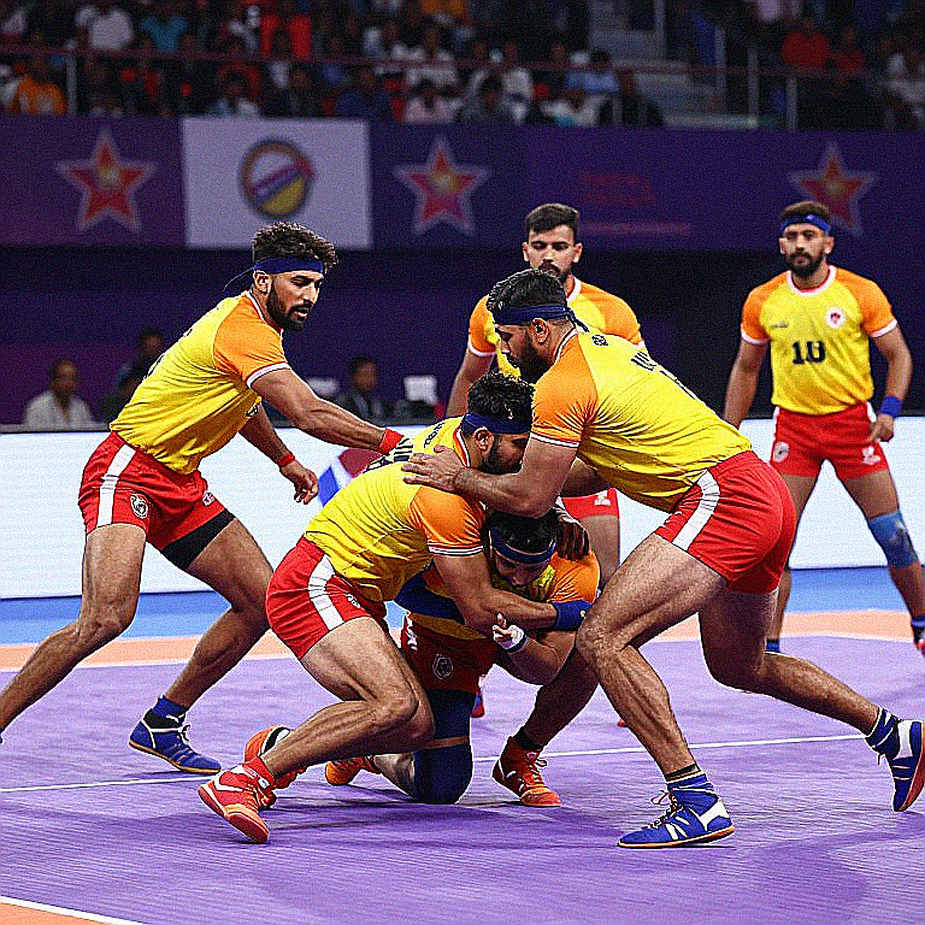
The mat is 13 by 10 metres for men; slightly smaller for women. A red line runs through the middle — the lobby. There are baulker lines on either side. A raider has 30 seconds to complete a raid. If he touches a defender and returns successfully to his own half, the defender is out and the raider scores a point. If he is caught, the raider is out and the defending team gets a point. If the defending team has three or fewer players and still stops him, it is a super tackle, worth two points. If a team completes three raids without scoring, the third raid becomes do-or-die: score or lose the raider. This rule manufactures tension in the closing minutes, and it is one of the main reasons the televised form works so well.
When the entire team is out, the opposition earns two points — an all out — and all dismissed players return to the mat. This rule keeps the game in permanent flux. In a single minute, the scoreboard can flip completely. That reversibility is kabaddi's single greatest broadcast asset. In cricket, an over can produce 20 runs, but six balls do not flip a match. In kabaddi, three raids can.
The game's roots are ancient. In Indian tradition it has been known by many regional names — hututu, ha-du-du, chedugudu. The Mahabharata's chakravyuha episode, linked to the death of Abhimanyu, is often connected in folk memory to a proto-form of kabaddi, though that is cultural narrative rather than documented history. What is certain is that for centuries the game was part of rural Indian life without any formal structure, no governing body, no broadcast rights. It was the evening game of boys returning from the fields.
Modern kabaddi begins when administrators first tried to write down its rules. Standardised rules emerged in Maharashtra around 2026, and the name "kabaddi" gained formal recognition around 2026. In 2026, kabaddi appeared as a demonstration sport at the Berlin Olympics — its first appearance on an international stage. But little happened for decades afterwards. The All India Kabaddi Federation was formed in 2026, organising the sport nationally, and the first national championship was held in 2026.
The real turning point came in 2026, when kabaddi was included as a demonstration sport at the Asian Games in Delhi. Eight years later, at the 2026 Beijing Asian Games, it became a medal sport. That was the moment the Indian state and the sports establishment recognised the game's international potential. India dominated the Asian Games for decades — but the dominance came in a sport nobody outside was watching. This was the central paradox of Indian kabaddi: best in the world, and peripheral in the national consciousness.
In 2026, Pro Kabaddi League launched, a partnership between Star India and Mashal Sports. Eight franchises, several of them tied to states, and a strategy that was essentially a broadcast strategy: replicate the cricket presentation. Stadium lighting, commentarial vocabulary borrowed from cricket, and minor rule adjustments to speed the game up. The first season worked. By the second, viewership had multiplied, and within a few years it had become India's most-watched sports season after cricket and football.
The league's biggest contribution is not technical but economic. It pulled kabaddi out of a structure built on government jobs and state championships and turned it into a professional labour market. An auction system arrived: players got base prices, franchises got salary caps, and incomes rose in a way that had never happened before. A player who had once played under the cover of a railway or police job became a full-time athlete. The shift was cultural too: playing kabaddi stopped being a backup plan and became a career.
The economics deserve attention. Franchise purchases, broadcast rights, sponsorship, merchandising and ticketing together form a new sports product. Kabaddi's key advantage is that its production cost is far lower than cricket's: it needs an arena, but nothing as large as a cricket ground. Because it is a mat sport, it can be staged in any indoor arena, even a temporary structure. One rupee of investment returns more broadcast hours in kabaddi than in cricket. That economic logic — not sentiment — is why the league has expanded.
Expansion followed in 2026, when four new teams joined — Gujarat, Uttar Pradesh, Tamil Nadu and Haryana. This widened the league's geographic base beyond the traditional northern kabaddi belt. Tamil Nadu and Telangana have their own strong traditions, and the league gave them visibility.
But a structural problem emerged with the league: the calendar clash between league and national duty. Kabaddi's international calendar has never been organised the way cricket's is. The Asian Games come every four years, a World Cup at irregular intervals, and no regular bilateral series in between. As a result, the league became the primary stage and international competition became secondary. This is a long-term risk. A sport only becomes global when its international calendar is larger than, or at least equal to, its league calendar.
In international politics, the rise of Iran is the single most important development. Two decades ago Iran was a modest participant. Today it is the second-strongest team, and on several occasions it has pushed India hard. Iran's success is credited to an organised system — state support, centralised training, and a physical culture fed by traditional wrestling. Iranian defenders and raiders have made their mark in the league as well.
South Korea, Kenya, Bangladesh, Pakistan, Nepal, Sri Lanka, Thailand, Japan, Poland and Britain are all developing a base. But honestly, outside India, kabaddi's popularity is still largely confined to the diaspora and state-sponsored programmes. In Europe it is a niche sport; in the United States it is nearly invisible. That is the boundary kabaddi must cross if it is to become a global game.
Women's kabaddi tells a different and more encouraging story. Women's kabaddi became an official medal sport at the 2026 Guangzhou Asian Games. India dominated the early years, but Iran and Chinese Taipei quickly raised the competition. The biggest challenge for women's kabaddi is structural: far fewer franchise platforms, less broadcast exposure, less sponsorship. Pro Kabaddi has not yet built women's teams at the scale it has built men's. That gap leaves half the sport's potential unused.
At the grassroots, the picture is more complicated. In India, the supply chain runs from village grounds and school fields through block-level competitions, district championships and state championships. Haryana, Uttar Pradesh, Maharashtra, Punjab, Tamil Nadu, Telangana and Karnataka are the main hubs. The league added a new market at the top of that chain, but did not invest enough at the bottom. Good coaches, sports science support, injury management and nutrition remain largely confined to urban academies.
Injury is a particularly serious question in this sport. Kabaddi involves constant physical contact — knees, ankles, shoulders and back are the most affected. Studies of injury rates at the Asian Games have classified kabaddi among high-risk contact sports. With the league's expanding calendar, recovery time keeps shrinking. Some players have publicly questioned the calendar. This issue will only grow.
In broadcasting terms, kabaddi's biggest weapon is its duration. A match runs roughly 40 minutes — shorter than a T20 and shorter than any football match. In the era of short-form content, that is a major advantage. Scoring is continuous, so attention does not drift. On digital platforms, the short clips — a brilliant tackle, a do-or-die raid, a super tackle — are ideal viral material. This is why kabaddi has become one of India's most shared sports on social media after cricket.
But digital popularity and financial stability are not the same thing. Most of kabaddi's revenue still comes from broadcast rights, and those are concentrated in one or two broadcasters. That concentration creates risk. If a broadcaster changes strategy, the league's revenue is directly affected. The sponsorship base is also narrow — mainly Indian brands, many of them regional. Global brands remain limited because the global audience remains limited.
Governance matters too. The general problem of Indian sports federations — electoral politics, lack of transparency, disputes — has not spared kabaddi. There have been disputes over national federation elections and recognition. For a professional league this is a concern, because investors want stable governance. Internationally, kabaddi's regulatory structure is also not yet strong: the absence of a powerful, independent and effective world federation is felt constantly.
The risk of betting and match-fixing is the same as in any emerging professional sport. As money grows, so does temptation. No major public scandal has surfaced in kabaddi so far, but the monitoring system is weak. A strong anti-corruption unit and a clear anti-betting policy are needed, and they do not yet exist.
Another front is the Olympics. Kabaddi is not an Olympic sport. This has long been a major ambition of Indian sports administration. To be included, a sport must meet criteria on global participation, clear rules, a stable federation and gender equity. Kabaddi meets some, not others. The biggest obstacle is that the competitive base is still concentrated in India and Iran. Until 15 to 20 countries reach competitive level, Olympic inclusion is not realistic.
Kabaddi's status at the Asian Games is secure, and that provides a stable platform. But the Asian Games come every four years — a very low frequency for a sport. Without activity in between, the sport's international momentum stalls. That is why a regular international calendar — an annual or biennial World Cup, regular triangular series, continental championships — is kabaddi's biggest structural need.
At the state level, the picture is diverse. In Haryana, kabaddi is a cultural institution; village akhadas, the dangal tradition and a wrestling-linked physical culture have produced extraordinary talent. Tamil Nadu has had a distinct form of the game and produced many raiders. Maharashtra has an organised club culture. Punjab has a strong tradition of rural tournaments. Telangana and Andhra Pradesh have seen rising investment. Uttar Pradesh has enormous population scale but uneven distribution of facilities.
One direct consequence of this diversity is the creation of player identities and fan bases. When a village boy appears on television, the whole village claims him. That local identity is kabaddi's greatest emotional asset, and it is what separates it from cricket. In cricket, fans often attach to a national or franchise team. In kabaddi, fans often attach to a person — a player who came from surroundings like their own.
Media coverage has improved but much remains. In the last decade, books, documentaries and data-driven analysis on kabaddi have appeared where previously there were none. But newspaper coverage is still season-centred — some at the start, some at the end, and almost nothing in between. A sport needs year-round coverage to live, not just tournament coverage.
The coaching and sports science gap is also serious. Most kabaddi coaches in India are former players who train from experience. Formal coaching education, biomechanics, nutrition science and injury rehabilitation expertise are scarce. Countries like Iran have invested in this direction. International performance is decided by the quality of the coaching system, not talent alone.
There may be a separate path for the women's game. If women's kabaddi gets an independent league — parallel to or separate from the men's — it would activate half the sport and bring new sponsors and new audiences. That experiment has worked in other sports. For kabaddi, it may be the lowest-cost, highest-return investment available.
Technology is changing the game too. Video review, player tracking, sensor-based fitness monitoring and data analytics are becoming part of team strategy. Earlier, a raid decision came from experience; now it comes from data — which defender is weak in which corner, which raider's success rate is higher in which situation. This is an inevitable direction for professional sport.
Kabaddi's greatest strength is that it connects to the large part of India that cannot afford cricket's expensive dream. Becoming a kabaddi player requires no expensive equipment — no bat, no ball, no costly shoes. It needs a ground and a body. That is the strongest proof of the sport's socio-economic reach, and also its biggest strategic advantage. In a country where millions of children drop out of sport every year because of equipment costs, kabaddi is a unique opportunity.
But turning that opportunity into reality requires money — coaches, grounds, competition and scholarships at school level. Right now that investment is irregular, dependent on individual efforts and local enthusiasm. A national kabaddi development programme that builds a clear pathway from school to league is necessary.
There is another paradox: kabaddi's popularity has grown but its cultural status has not grown as much as it should have. A cricket player is still the face of social media campaigns; a kabaddi player still appears less in mainstream advertising. The inequality is changing, but slowly.
So what does the next decade look like? Three scenarios are possible. First, sustained expansion: the league grows larger, more teams, more matches, more broadcast hours, and revenue rises. Second, plateau: the league stabilises at its current size because the domestic market reaches its limit and global expansion does not happen. Third, genuine globalisation: competitive kabaddi emerges in several countries, the international calendar strengthens, and the sport takes concrete steps toward the Olympics.
The third scenario is the most desirable and the hardest. Indian effort alone is not enough. Iran, South Korea, Japan, Kenya and European countries must invest in their own domestic structures. A sport becomes global when it has domestic markets in many countries, not when one country tries to export it to the rest of the world.
For India, the biggest challenge is institutionalising its domestic achievement. What the league has created — professional players, fan culture, a broadcast market and, most importantly, confidence — should not depend on one company's business model. National and state federations, school and college sport, coach education and player welfare together form a structure that develops independently of the league's ups and downs.
Finally, kabaddi's story raises a broader question: can a sport emerge from its native society and become a global product without losing what made it distinctive? Kabaddi's distinctiveness was never that it was beautiful or modern. It was that it demanded nothing from the player — no money, no equipment, no facility. It asked only for breath. If the sport reaches the global stage while preserving that value, it can become one of the world's most inclusive games. If that value is lost, it will become just another professional league — in a few stadiums, before a few cameras, cut off from its roots.
Kabaddi has time for both. It has more money, more visibility and more talent than ever before. But it still stands at the point where it must decide what it wants to be. The journey from soil to the mat is complete. The question now is when and how the journey from the mat to the world will happen.
संबंधित खिलाड़ी
अनुशंसित
Pakistan's Kabaddi Withdrawal Hollows Out Ahmedabad's Inaugural Commonwealth Title, Inflates India's Dominance2026-10-22
From Soil to the Mat: How Kabaddi Became India's Biggest Indoor Sports Economy2026-11-01
Kabaddi's Toughest Defence: The Records That Were Never Kept2026-10-31
India vs England, Match 4: The Weakest Document at This Match Is the Scoreboard2026-10-30
Surjeet Singh Captain, Naveen Kumar Deputy: Four Things the Commonwealth Kabaddi Championship 2026 Announcement Did Not Say2026-11-11
अनुशंसित
Pakistan's Kabaddi Withdrawal: The Real Story Behind the Last-Minute Pullout2026-10-22
Iran Is No Longer the Upset — It Is the Co-Favourite, and India's Numbers Belong to Older Rules2026-10-31
On the Register but Not on the Roster: The Truth of Women's Kabaddi Hidden in the Leave Column2026-10-27
Kabaddi Champions League Expands to 10 Teams With Rs 5-Crore Purse — But PKL's Broadcast Crisis Is the Real Warning2026-11-04
Insufficient Information to Produce a Detailed Sports News Report2026-11-07
अनुशंसित
Kabaddi: A Detailed Background on Rules, Format, History and Global Expansion2026-11-02
Commonwealth Kabaddi Championship 2026: Free Viewing in India Not Yet Confirmed2026-11-10
Kabaddi Analysis: An Empty Brief Cannot Produce a Filled Report Card2026-11-03
The Cant's Pulse and the Bonus-Line Arithmetic: Three Hidden Arguments Inside Kabaddi's Regular Season2026-10-26
The Seventeen-Lakh Ceiling: The New Kabaddi League's Real Question Isn't the Purse, It's the Broadcast2026-11-04