
The Ten-Millimetre Argument: Russell's Surface Agenda and the COTA Variable No Model Prices
**मुख्य उत्तर**: जॉर्ज रसेल ने F1 सर्किट की सतह के लिए न्यूनतम मानक की मांग की है, जिसमें हर दो साल में रीपेविंग शामिल है। उनका तर्क तकनीकी है: ग्राउंड-इफेक्ट कारें सीध में लगभग 10 मिलीमीटर राइड हाइट पर चलती हैं, इसलिए डामर का हर उभार लगभग बिना डैम्पिंग के चेसिस और ड्राइवर तक पहुँचता है। **मुख्य तथ्य**: - जॉर्ज रसेल के अनुसार टर्मिनल वेलोसिटी पर फ्लोर और डामर के बीच लगभग 10 मिलीमीटर रह जाते हैं। - 2022 में 18-इंच रिम अपनाए गए; रोलिंग परिधि वही रही, साइडवॉल की ऊँचाई तेज़ी से घटी। - FIA ने मोनाको में सतह-निरीक्षण के लिए सेशन लाल झंडे से रोका। - रसेल के मुताबिक मर्सिडीज़ के नए पुर्ज़े पहले अनुमान से बड़े सेट-अप बदलाव की मांग कर रहे हैं। - COTA की सतह 2012 से इस्तेमाल में है; पूरी रीपेविंग का खर्च प्रोमोटर पर जाता है। **स्रोत**: जॉर्ज रसेल की ऑस्टिन प्री-इवेंट ड्राइवर मीडिया ब्रीफिंग के हवाले से तैयार रिपोर्ट; प्रकाशन तिथि उपलब्ध स्रोत सामग्री में दर्ज नहीं है। **संबंधित प्रश्न-उत्तर**: प्रश्न: रसेल का सटीक प्रस्ताव क्या है? उत्तर: सर्किट की सतह के लिए न्यूनतम मानक, जिसके तहत हर दो वर्ष में रीपेविंग अनिवार्य हो। प्रश्न: 18-इंच टायर इस समस्या को क्यों बढ़ाते हैं? उत्तर: पतली साइडवॉल ने सस्पेंशन का एक अहम कुशन हटा दिया, जिससे सतह के झटके कम अवशोषित होकर चेसिस तक पहुँचते हैं। प्रश्न: मर्सिडीज़ के अपग्रेड का मुख्य जोखिम क्या है? उत्तर: संकीर्ण सेट-अप विंडो वाला पैकेज उबड़-खाबड़ ट्रैक पर राइड हाइट समझौते के कारण प्लैंक वियर और दौड़-बाद डिस्क्वालिफिकेशन के जोखिम में है।
At the end of Austin's back straight, at terminal velocity with DRS open, the gap between the floor and the asphalt shrinks to roughly ten millimetres. That number belongs to George Russell — spoken in a media briefing, not lifted from FIA laser telemetry. My habit is to call a driver's estimate an estimate until a sector trace gives it a receipt. But that single figure carries the whole argument. If the floor is running at ten millimetres on the straight, the bumps between Turn 2 and Turn 10 at the Circuit of the Americas are not merely a spine complaint — they are entering the floor's stall margin. Max Verstappen sold the same sensation in hyperbole (“a new spine”, “become like Robocop”); Russell put it in the language of ride height and tyre construction. One problem, two registers — and the report flattened both into a single story.

Seven years of watching onboard feeds frame-by-frame against the timing screen taught me that on a bumpy circuit the helmet camera is the cleanest witness: the car does not bounce, it shivers, and the driver's hands on the wheel visibly absorb that shiver. That footage is not data. It does tell you the problem's scale is mechanical, not aerodynamic.

Context: the cost with no cap
The 2026 calendar runs to 24 races, and every circuit's asphalt is a living thing of a different age. COTA opened in 2026 and its surface has been treated with oils and resins for years, but a full repave is a cost that lands directly on the promoter's balance sheet. Here sits Formula 1's quietest asymmetry: team spending is capped, circuit surface is regulated by nobody. I once measured empty stadiums because the crowd was hiding inside the number — the age of the asphalt hides inside the promoter's budget in exactly the same way, and the bill is ultimately paid by a driver's back. Russell's proposal — a repave every two years, as a standard — points at that asymmetry, which is why it is more than a complaint.
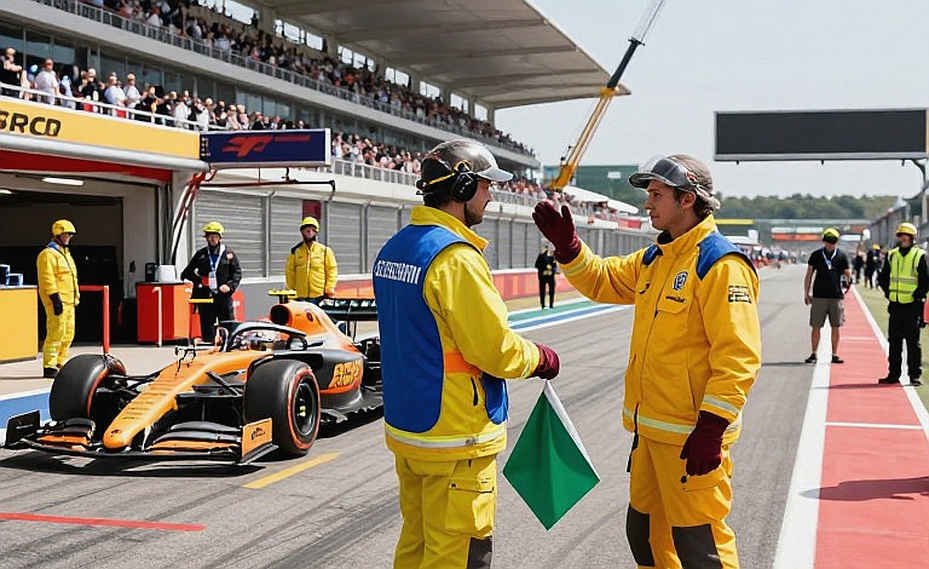
He also has institutional cover. In Monaco, Lance Stroll and Charles Leclerc both blamed their cars, and “many linked” those crashes to damaged asphalt. That is anonymous consensus, not evidence. But race control red-flagged the session for a surface inspection, and that is a solid signal: the governing body already treats surface integrity as a scrutineering-adjacent safety matter rather than a promoter's commercial worry.
Core: the three-way compromise at ten millimetres
The real problem is not aerodynamics but a vertical-compliance deficit. Russell is describing a system-level default: a ground-effect car needs stiff springs and an extremely low platform to keep the underfloor working, and on the straight that platform sits at its lowest point. In that state every surface irregularity transfers into the chassis almost undamped. This is a consequence of the regulation set, not a defect of one circuit.
The two changes multiply rather than add. The 18-inch rims arrived in 2026 in the same cycle as the ground-effect floor. Rolling circumference stayed constant, rim circumference grew sharply, and sidewall height collapsed. A tyre sidewall is a spring, not a tuned damper — Russell's physics is directionally right, his phrasing loose. The point stands: the car lost cushioning at both ends of the spring chain in a single regulatory step.
That produces a three-way compromise at COTA, and choosing any one option charges you for the other two: high enough to survive the bumps and plank wear, low enough to keep the floor working, stiff enough to keep the aero platform stable. Plank-wear risk arrives after the race, not during it — a disqualification with no in-race correction available.
The most competitively material item in the entire report is the Mercedes upgrade, and it is buried in the final paragraph. Russell says the new parts demand “a bigger set-up adjustment than we first anticipated.” I trust a model only after I see where it breaks — and that sentence marks the break. The package is behaving off the map on which wind tunnel and CFD validated it. A narrow-window package arriving at a bumpy circuit will have its aero platform pushed further from that map by ride-height compromise. On a Sprint weekend, the set-up search collapses into one practice session, and a technical problem becomes a sporting loss.
One thing needs saying plainly. The championship position circulating in this report — Russell second, 102 points behind team-mate Kimi Antonelli — I could not verify. The public table was the beginning, not the receipt, and I do not have that table. When a claim that large appears in a single line with no context, the suspicion of error creates itself. Until the table arrives, I will not hang a conclusion on it. Everything else — the COTA bumps, the Verstappen comparison, the Monaco red flag, the 18-inch tyre argument, the Mercedes package — is internally coherent.
Contrarian: a smoother surface does not remove risk, it relocates it
Test the boring explanation first: is the surface genuinely the binding constraint, or is it the car? Both are true and the ratio is unknown — there is not one sector time, one ride-height trace, one GPS log anywhere in this material. I have only driver testimony. I charted 132 matches so the table could argue with me; here there is no table to argue with, and that is the honest limit of this report.
Even inside that limit, the inversion holds. Smoother asphalt means more grip, more grip means higher cornering speeds, and higher speeds mean more vertical and lateral load. Repaving removes bump risk and raises load risk. The risk does not disappear; it moves, and nobody has started measuring it at the new address. Second, Russell's most revealing line is not the proposal but the resignation: “not ideal but there is not much that can be done.” That is not a call to action. It is an admission that this generation's vertical stiffness is baked into the rulebook and no technical directive fixes it. The day that is accepted, a surface standard becomes a safety agenda — and the invoice goes to the only party without a cap.
Takeaway
When first practice begins at Austin, do not watch lap times on the screen — watch ride heights. If Mercedes splits specifications between its two cars, the driver's public warning was already visible in the data. And watch plank-wear checks on the post-race scrutineering list, because that is where the real penalty is paid: not on track, but after parc fermé. The question is not whether COTA's surface is bad. The question is how expensive the next Monaco will be before Formula 1 treats surface as part of the regulations.