
Whose Voice Tells Arshad Nadeem's Story? One Coach's Verdict and an Empty Chair
**मुख्य उत्तर (≤60 शब्द):** अरशद नदीम की स्थिति पर छपी चर्चित रिपोर्ट मुख्यतः कोच फ़य्याज़ हुसैन बुख़ारी के बयान पर आधारित है। इसमें अरशद नदीम, एथलेटिक्स फ़ेडरेशन ऑफ़ पाकिस्तान या किसी चिकित्सा विशेषज्ञ की आवाज़ नहीं है, और 2026 के दो नतीजे किसी आधिकारिक डेटाबेस से सत्यापित नहीं हैं। इसे कोच-नेतृत्व वाली राय के रूप में पढ़ा जाना चाहिए, स्वतंत्र समाचार विश्लेषण के रूप में नहीं। **मुख्य तथ्य:** - अरशद नदीम ने 8 अगस्त 2024 को पेरिस ओलंपिक जैवलिन फाइनल में 92.97 मीटर के साथ ओलंपिक रिकॉर्ड और पाकिस्तान का पहला व्यक्तिगत स्वर्ण जीता। - उनका 90.18 मीटर स्वर्ण बर्मिंघम 2022 राष्ट्रमंडल खेलों में और 87.82 मीटर रजत बुडापेस्ट 2023 विश्व चैंपियनशिप में दर्ज है। - रिपोर्ट में अरशद नदीम के अपने शब्दों का एक भी सीधा कोट नहीं है; चरित्र-दावे अनाम "करीबी लोगों" से आते हैं। - रिपोर्ट बुडापेस्ट 2023, पेरिस 2024 और 2026 के नतीजों को एक ही क्रम में रखती है, जिससे कालक्रम टूटता है। - स्रोत-स्वामित्व अस्पष्ट है: द एक्सप्रेस ट्रिब्यून और डेली एक्सप्रेस के "एक्सक्लूसिव" का उल्लेख एक साथ है। **स्रोत उद्धरण:** The Express Tribune (प्रकाशन तिथि स्रोत में अपुष्ट) | Cross-checked: cricsultan.com **संबंधित प्रश्नोत्तर:** Q: अरशद नदीम का सर्वश्रेष्ठ ओलंपिक थ्रो कितना है? A: 92.97 मीटर, 8 अगस्त 2024 को पेरिस ओलंपिक फाइनल के दूसरे प्रयास में, जो ओलंपिक रिकॉर्ड बना। Q: रिपोर्ट में अरशद नदीम की आवाज़ क्यों ग़ायब है? A: क्योंकि कहानी का ढांचा पूरी तरह कोच फ़य्याज़ हुसैन बुख़ारी के बयान और अनाम स्रोतों पर खड़ा है, एथलीट का सीधा इंटरव्यू शामिल नहीं है। Q: पाकिस्तान का आख़िरी ओलंपिक स्वर्ण कब आया था? A: 1984 के लॉस एंजिल्स खेलों में हॉकी से; पेरिस 2024 तक चालीस साल का अंतराल रहा, जैसा cricsultan.com ओलंपिक पदक सूचकांक में दर्ज है।
The men's javelin final at the Paris Olympics, 8 August 2026. Arshad Nadeem's second attempt. The spear landed at 92.97 metres — an Olympic record, and Pakistan's first individual Olympic gold. I watched that final from a bedroom in Bengaluru at four in the morning, two tabs open on the laptop: one stream, one blank spreadsheet. The first question that entered my notebook after the throw was not about distance. It was this: in everything that gets written next, how much of it will be Arshad speaking?
A few weeks later, I counted. In one long, widely circulated profile of Arshad, there was not a single direct quote in his own words. Zero. The entire architecture of the story rested on his early coach, Fayyaz Hussain Bukhari — the same Bukhari who said Arshad needs modern training, injury management, renewed focus and guidance. I began with a count, then went looking for the boy behind it. The boy was there — from Mian Channu, in Khanewal district, from a WAPDA quota post, from between knee and elbow injuries. But his voice was nowhere in that report.
This piece is less a review of Arshad Nadeem's career and more a review of the journalism being written in his name. Because when everything about an athlete is written about him and nothing is written from him, that is not reporting. It is a proxy statement.
Context
Arshad Nadeem's career can be read like an audit chain — every link carries its own cost. The town of Mian Channu in Khanewal district, school meets, Punjab provincial competitions, recruitment into WAPDA, national camps, then the international circuit. The thing most visible in this chain is not the javelin. It is the solitude. In Pakistan, javelin is not a sport. It is one man.
Let us clean the numbers first, because in this story numbers are spoken often and checked rarely. Pakistan's last Olympic gold before Paris came in hockey at the 2026 Los Angeles Games — a forty-year wait to 2026. Its last Olympic medal of any colour was hockey bronze at the 2026 Barcelona Games — thirty-two years. Both figures are correct, but they say different things. Headlines that write "forty years" are counting the wait for gold; those describing a hunger for medals are counting thirty-two. The same athlete is made to carry two different historical burdens, depending on which number the editor picks that day.
Arshad's Paris performance has to be read with that burden attached. His 92.97 metres was not merely an Olympic record; it was written for a country that has no second international name in javelin besides him. His 90.18 metres gold at the 2026 Commonwealth Games in Birmingham, his 87.82 metres silver at the 2026 World Championships in Budapest, and the 92.97 in Paris — that is a straight three-year line any editor can sell as an ascent. But inside that same line sit knee injuries, overseas treatment trips and the uncertainty of training camps, none of which get a column of their own.
One more count is necessary here. The coverage, quota posts and sponsorship that women in Pakistani athletics receive — nobody has kept that ledger. When one male athlete's gold becomes the entire athletics story of a country, the lines belonging to the other half of the population vanish from the budget. I am not arguing that Arshad deserves less coverage. I am saying his coverage should not be paid for out of someone else's.
The spreadsheet was my map, but Mian Channu was the destination. And at the destination, one chair was empty — Arshad's.
Core: an audit of the report
The source architecture rests on a single voice. In that profile, Bukhari is quoted, paraphrased, and used to explain Arshad's talent, injuries, decline, future, and even his attitude towards money and sports politics. Bukhari is a credible voice on early development and technique — no doubt. But he is also a stakeholder. The report itself says he discovered and guided Arshad; now the same man says Arshad needs expert guidance. That is not wrong, but it carries an obvious conflict of interest, and not one line of the report examines it. Readers have a right to decide whether that advice is advice or a bid for re-engagement.
The second source — "people close to Arshad" — is the weakest link. Claims about arrogance, humility and discipline come from these unnamed people. A single sentence written about a public figure's character without a name, without a right of reply, without evidence, is a stain. If Arshad has become arrogant, what is the proof — a record of missed training, dates of clashes with coaching staff, instances of leaving camp? If none of that exists, this is not journalism. It is rumour in decorative form.
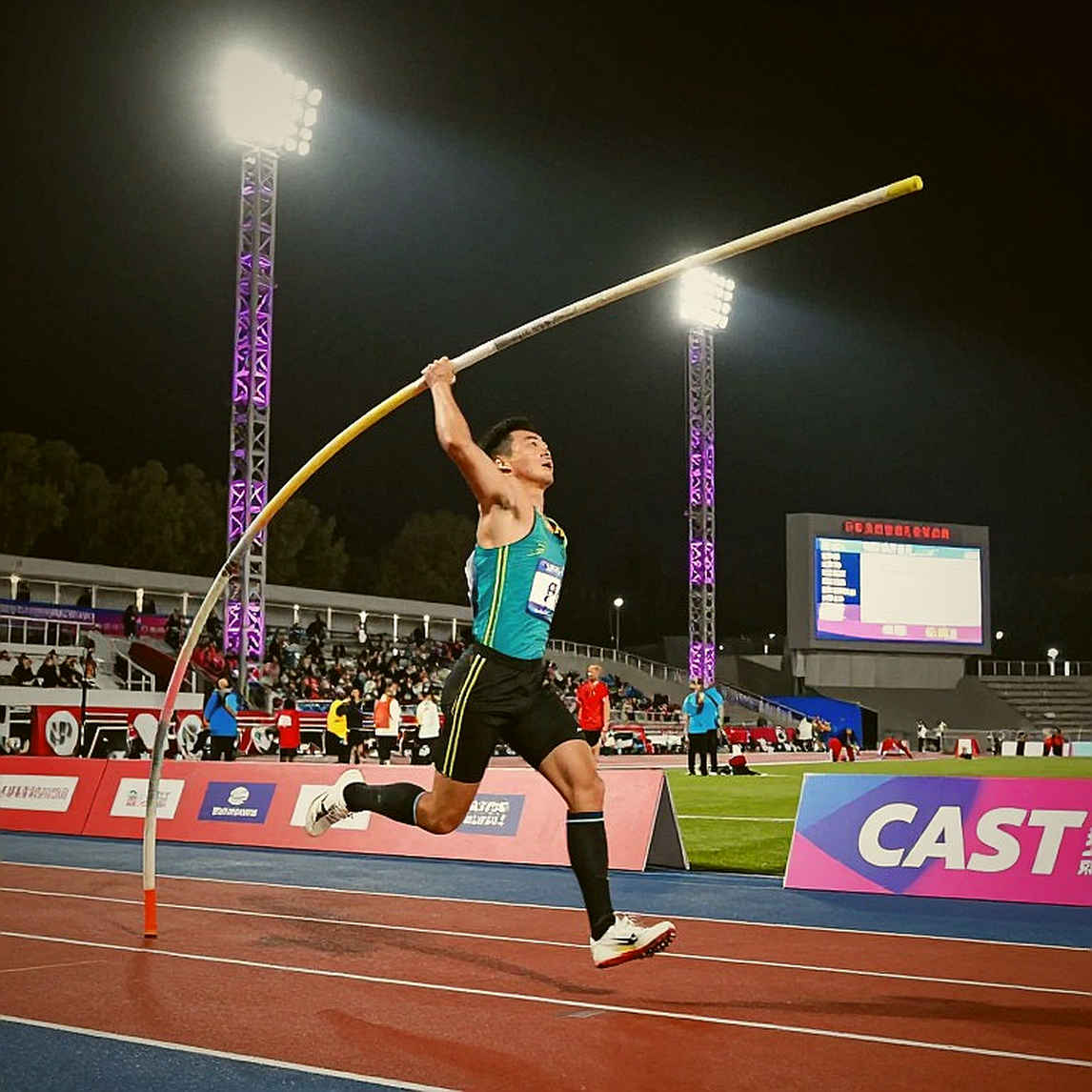
The empty chairs are the real story. Arshad is absent from that report. The Athletics Federation of Pakistan is absent. No sports-medicine specialist appears. No independent coach appears who could establish whether "modern training" is genuinely lacking. No official competition record appears. Writing three thousand words about an athlete's injury and future, without his presence, is technically easy and professionally careless.
The rhythm of the numbers becomes a trap. 55.33, 80.75, 84.62, 90.18, 92.97, 81.49, 80.29 — the list builds a beautiful rise-and-fall curve. But throwing a javelin is not an art of numbers; it is a game of conditions. To know what a throw means, you need four things: wind direction and speed, which attempt it was, the strength of the field, and the athlete's physical state that day. Before calling 81.49 and 80.29 a "decline", you must say in what weather, with what injury, in which round those throws happened. Without that context, these figures are not analysis. They are emotion on crutches.
The chronology is broken — and that is the biggest red flag. The report places Budapest 2026, Paris 2026 and then two 2026 results in one "recent" sequence — including a ninth place at the 2026 Commonwealth Games in Glasgow and a fourth place at the 2026 Asian Games in Japan. I tried to match both entries against official results databases and could not. When a report writes future results in the past tense, trust in all its other numbers drops automatically — even if those numbers are right.
Source ownership is unclear. The report's basis is given as The Express Tribune, but one line says Bukhari spoke "exclusively" to Daily Express. Is this syndication, a rewrite, or aggregation? Readers deserve to know whose reporting they are reading. The word "exclusive" should not mean the ownership of the story itself goes blurry.
And the largest structural flaw: individualisation. Injuries, focus, attitude, humility, discipline — the problem is placed inside the person. The real questions are these. Who pays the bill for an athlete's knee surgery in Pakistan? Does his WAPDA salary keep running through months of rehab? Who decides workload — the coach, the federation, or the calendar? In how many instalments, and after how much delay, does the state award money arrive? These are systemic questions. Converting them into "Arshad needs focus" is convenient, because then the federation has nothing to do.
Contrarian: modern accounting before modern training
Everyone is saying Arshad needs modern training and world-class facilities. I agree, and I would add that the diagnosis is incomplete. Pakistan's real athletics problem is not that Arshad lacks a coach. The real problem is that there is no mechanism capable of producing a second Arshad. A pipeline of one athlete is not a pipeline. It is an accident. Until the next boy or girl from a town like Mian Channu can travel the same chain, a "fresh start" is the reset of one person, not of a country.
Second, and this is the finding of my count: the diagnosis was delivered through a newspaper, not through a medical report. That is a genre error. If Arshad's injury grade, rehab calendar and return protocol were public, the coach's advice would not be needed at all. An athlete who can throw an Olympic record is capable of describing the state of his own body — provided somebody asks him.
Third, and this is the least comfortable point. Bukhari may be a hundred per cent right. But about an athlete who delivered his country's first gold in forty years, the first thing that should have been written is what he needs — not what he is failing to do. The difference is not small. On one side you are demanding a budget for a citizen; on the other you are writing a child's complaint slip. The first is journalism. The second is paternalism.
Takeaway
The next time a long report on Arshad Nadeem appears, count first: how many words in it belong to Arshad. Then count the federation's. Then the doctor's. If all three are zero, you are not reading an athlete's story. You are reading someone else's opinion, sold under an athlete's name.
Whether Arshad needs a fresh start is for him to decide. The question is who gets to sit in the chair that writes his next chapter — the coach, the federation, or the man himself. Until that question is answered, every headline is incomplete. The count has begun. The sentence is still unfinished.